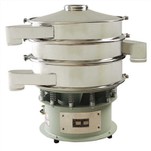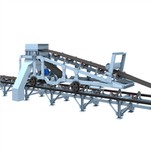


The process of dividing the bulk material groups with different particle sizes into several different levels is divided into several different levels by passing through a single or multi-layer screen surface with uniform porosity for many times. Particles larger than the sieve hole remain on the sieve surface, which is called the sieve surface of the sieve surface, and particles smaller than the sieve hole pass through the sieve hole, which is called the sieve bottom of the sieve surface. The actual screening process is: a large number of fragmented materials of different particle sizes and mixed thicknesses enter the screen surface, only a part of the particles are in contact with the screen surface, due to the vibration of the screen box, the material layer on the screen is loosened, so that the gap that already exists in the large particles is further expanded, and the small particles take the opportunity to pass through the gap and transfer to the lower layer or the transport aircraft. Due to the small gap between small particles, large particles cannot pass through, so the original chaotic arrangement of particle groups has been separated, that is, layered according to particle size, forming an arrangement rule of small particles below and coarse particles on top. The fine particles that reach the sieve surface are smaller than the sieve holes, and finally realize the separation of coarse and fine particles and complete the screening process. However, adequate separation is not available, and during screening, a part of the sieve is generally left in the sieve material. When fine particles are screened, although the particles are smaller than the sieve holes, they have different degrees of difficulty in screening, and it is more difficult for particles with similar material and screen hole size to be screened, and it is even more difficult to pass through the particle gap in the lower layer of the sieve surface.