


Shaftless Screw Conveyor
Shaftless Screw Conveyors: The Solution for Sticky and Tangled Materials
Traditional screws often struggle with wet, sticky, or stringy materials that wrap around a central shaft. Our Shaftless Screw Conveyor eliminates this problem entirely. By using a heavy-duty, centerless spiral, this conveyor provides a large, unobstructed flow path that prevents clogging and "bridging."
It is the industry standard for wastewater treatment (sludge handling), pulp and paper, and municipal solid waste.
Key Advantages:
- Clog-Free Performance: Handles sludge, refuse, and entangled fibers with ease.
- Large Capacity: More interior space for bulky or irregular-shaped materials.
- Internal Liners: Equipped with high-density wear-resistant liners (UHMWPE) for low friction and long life.
What is Shaftless Screw Conveyor
A shaftless screw conveyor has only one spiral or helix without a central shaft. The shaftless screw conveyor rotates on a liner that is usually made of engineering plastic. The only connection point on a shaftless screw conveyor is at the drive end of the screw conveyor.
Why choose us?
Custom Engineering Services
Kunwei Machine doesn't just sell equipment; we provide tailored engineering solutions. Based on your material density, lump size, and moisture content, our engineers calculate the optimal belt tension and motor power to ensure energy efficiency and system longevity.
Global Project Experience
With decades of experience in the bulk material handling industry, Kunwei has successfully delivered belt conveyor systems to mining and construction projects in Southeast Asia, Africa, and South America. We offer full technical support, from initial design drawings to overseas installation guidance.
Complete Product Qualifications
Our products all have passed test of ISO90001. All of our products comply with international quality standards and are greatly appreciated in a variety of different markets throughout the world.
Competitive Price
You can get our catalog online or visit our factory to see our products. We also provide competitive price and excellent customer service for all our customers.
-
 Tubular Shaftless Screw Conveyor | Fully Enclosed Dust-Fr...Kunwei Tubular Shaftless Screw Conveyors feature a 360-degree fully enclosed pipe design, ensuring maximum containment of odors and fine particles. Engineered for transporting sludge and stickyAdd to Inquiry
 -
 Trough Shaftless Screw Conveyor | Easy-Access Maintenance...The Kunwei Trough Shaftless Screw Conveyor (U-shape) is engineered for high-volume transport of bulk materials that are difficult to handle with traditional screws. The open-top U-trough designAdd to Inquiry
 -
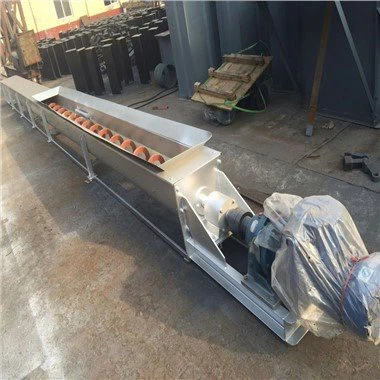 Stainless Steel Shaftless Screw Conveyor | Corrosion-Resi...Manufactured from high-grade 304 or 316L stainless steel, this shaftless conveyor is built to withstand highly corrosive materials and strict sanitary requirements. It is the gold standard forAdd to Inquiry


- Mob: +86-18336080841
- info@jinruimachine.com
- conveyor@jinruimachine.com
- vibratingscreen@jinruimachine.com
- Add: The West of Wuyang Road, Weibin District, Xinxiang City, Henan Province, China
Shaftless Screw Conveyors and Their 4 Advantages
A shaftless screw conveyor has for decades proved its superior qualities forr transport of a variety of bulk materials.
Shaftless screw conveyors can definitely make things easier for you – but it is not evident that everyone are aware of the use of screw conveyors.
Below we will mention 4 essential advantages by using a shaftless screw conveyor as opposed to belt conveyors, scoop elevators or augers.
Excellent Working Environment
Thanks to the encapsulated design; you can enjoy a dust free and safe working environment by using a screw conveyor. Housekeeping, as well as emissions are kept on a minimal level.
As an extra advantage, the noise level is kept very low thanks to the design, and the integrated wear liners. A shaftless screw conveyor is therefore ideal from an operator's perspective; even in demanding industries.
Low Operational and Maintenance Costs
Screw conveyors contain few moving parts; and require minimal maintenance at the same time as being energy efficient. During normal operational conditions – your screw conveyor will last for years which is beneficial for the total economy as regards to low costs for wear parts and standstill.
A screw conveyor has long life span, and your investment usually pays back in short time since the capacity is high, and the maintenance costs are low.
Space saving and Flexible Installations
With a shaftless screw conveyor – you will receive the possibility to transport both horizontally, diagonally and vertically. A vertical system is ideal when floor space is limited.
When bulk material is transported vertically; also a small space can be utilized efficiently and profitably in comparison with other types of conveyors and elevators.
It will be possible to transport vertically up to approximately 25 meters without re-loading of the material. Our longest screw conveyors which have been installed in a horizontal, or diagonal angle have been more than 60 meters long.
Quality Products Made in Småland
PST has all its production in Smålandic Torsås (Sweden). We design, manufacture, install and adapt screw conveyors to our clients for a number of industrial applications.
We take great grate pride in delivering our products all over the world at the same time as we are very much proud of helping to secure employment in our local district.
We at PST are more than a supplier of shaftless screw conveyors; we are collaborators with great competence within transport of bulk materials.
Shaftless Screw Conveyor Design Standards
Shaftless Screw Conveyors are designed to handle almost any bulk material, from dry and free-flowing to sticky and sluggish. Shaftless screw conveyors are ideal for bulk materials with high moisture content that have a tendency to adhere to the center pipe of a conventional shafted screw conveyor.
This problem is totally eliminated because there is no center pipe on a shaftless screw conveyor. Only the shaftless spiral is used to convey the bulk material.
After performance requirements and product characteristics are known, begins a systematic design process by applying proprietary calculations to determine conveyor size, rotational speed and horsepower to deliver the desired capacity. Due to the stresses associated with conveying sluggish and often abrasive bulk materials, high performance, heavy-duty materials of construction are integrated into a Shaftless Screw Conveyor system.
Since there is no center pipe to transmit torque, the shaftless spiral is designed to handle the full-motor torque load of the drive unit. Additionally, since the shaftless spiral has no center pipe for support, replaceable trough-conforming liners are used to evenly support the entire length of the rotating spiral.
|
SHAFTLESS SCREW |
SPIRAL OUTER |
DRIVE SHAFT |
OUTER SPIRAL |
INNER SPIRAL FLAT BAR |
DISK |
LINER |
RECOMMENDED |
|
6" |
5 1/2" |
2" |
5/8" THK. X 1 1/2" WIDE |
N/A |
1" |
3/8" |
14 GA. |
|
9" |
8 1/2" |
2 7/16" |
3/4" THK. X 3" WIDE |
N/A |
1" |
3/8" |
10 GA. |
|
10" |
9 1/2" |
2 7/16" |
3/4" THK. X 3" WIDE |
N/A |
1" |
3/8" |
10 GA. OR 3/16" |
|
12" |
11 1/2" |
3" |
1" THK. X 3" WIDE |
1/2" THK. X 2" WIDE |
1" |
1/2" |
3/16" |
|
14" |
13 1/2" |
3 7/16" |
1" THK. X 3" WIDE |
1/2" THK. X 2" WIDE |
1" |
1/2" |
3/16" |
|
16" |
15 1/2" |
3 7/16" |
1" THK. X 4" WIDE |
1/2" THK. X 2" WIDE |
1" |
1/2" |
3/16" |
|
18" |
17 1/2" |
3 15/16" |
1" THK. X 4" WIDE |
3/4" THK. X 3" WIDE |
1" |
1/2" |
3/16" |
|
20" |
19 1/2" |
3 15/16" |
1" THK. X 4" WIDE |
3/4" THK. X 3" WIDE |
1" |
1/2" |
3/16" |
|
24" |
23 1/2" |
4 7/16" |
1" THK. X 4" WIDE |
3/4" THK. X 3" WIDE |
1" |
1/2" |
3/16" |
Shaftless Screw Conveyors: a Perfect Solution for Handling Bulk Solids
The screw conveyor has been around since 267 BC when Archimedes came up with the brilliant idea to use a spiral incline plane to pump water for irrigation purposes. Since then, the screw conveyor has been used in thousands of industrial applications, every day, all over the world, for conveying and metering bulk materials.
While the basic concept of the screw conveyor has not changed, there have been many improvements in the design due to the needs of end users and the demands of the applications. The focus of this article is on shaftless screw conveyors. The shaftless screw conveyor is a fairly recent development in screw conveyor design and is growing in popularity because it is the perfect solution for many bulk solids handling applications.


Origin of the Shaftless Screw Conveyor
The shaftless screw conveyor was developed in the early 1940s in Europe as a means to convey dewatered biosolids for the wastewater treatment industry. Biosolids can be very sticky and sluggish, depending on solids content. Most biosolids consist of 20 to 30 percent solids with the balance being moisture contained in the solids. Figure 2 shows a typical shaftless screw conveyor for biosolids. The shaftless screw conveyor is the solution for conveying many difficult bulk solids. In fact, the shaftless conveyor was so successful in the wastewater treatment industry, that its use has been promoted in many other industries such as chemical, food and minerals processing.
Comparison of Shafted to Shaftless Conveyors
The shaftless screw conveyor is quite similar to a conventional shafted screw conveyor in design and construction. Both types of screw conveyors consist of a spiral or screw, troughs, trough ends, bearings, inlets, discharges, covers, and a drive unit. The unique difference between a shaftless and a conventional shafted screw conveyor is the spiral, or screw. A conventional shafted screw conveyor has a center pipe to support the screw flights, and the pipe is supported on each end by bearings. Typically, there is a half-inch gap between the outside diameter of the screw and the inside diameter of the trough and therefore, the screw never touches the bottom of the trough. In contrast, a shaftless conveyor is designed to be supported by a liner that conforms to the radius of the trough. The weight of the shaftless spiral is distributed over the full length of the spiral on the liner. The drive is connected to one end of the spiral by means of a flanged and bolted drive shaft and spiral end plate, while the tail end of the spiral is not connected and is allowed to rotate freely.
Applications for Shaftless Screw Conveyors
Most shaftless conveyors are designed to be used to handle bulk solids that have high moisture content. The handling of bulk solids discharged from centrifuges, filter presses, or mixers fall into this category and represent the proper application for shaftless screw conveyors. These bulk solids are typically sticky and difficult to convey in conventional shafted screw conveyors. Sticky bulk solids tend to adhere to the center pipe of a shafted screw conveyor where the flight meets the pipe. Shaftless screw conveyors totally eliminate this problem because there is no center pipe and only the spiral is used to convey the bulk solid. If your process consists of bulk solids with high moisture content, then the shaftless screw conveyor is a perfect solution.
Component Selection
When selecting the proper shaftless screw conveyor for your application, many factors must be considered. The spiral consists of a rectangular bar made of high-strength steel that is manufactured or rolled to the required diameter. Each shaftless screw conveyor manufacturer has its own unique alloy for the shaftless spiral. Some manufacturers have several spiral types to choose from, depending on the application. The strength and hardness of the spiral is very important to the long-term success of the installation. For example, if you are conveying an abrasive bulk solid, you need a spiral that is extremely hard in order to reduce the amount of abrasion on the shaftless spiral. Top manufacturers offer spirals with a hardness of up to 350-BHN. Since there is no center pipe to transmit torque, the shaftless spiral must be designed to handle the full-torque load of the drive unit. Make sure the shaftless screw conveyor manufacturer can back up their design with calculations for the torsional rating of the spiral.
The trough liner material is also important to the long-term success of the installation. Typical trough liner material is ultra-high molecular weight polyethylene or UHMW. UHMW is available in many different grades from virgin to oil-impregnated. Another popular trough liner material is Xylethon. Both of these materials are tough and have a low coefficient of sliding friction. Since the spiral is bearing down on the liner and rotating, it helps to have a tough, slick liner material. The liner material is typically the wear item and is easier and less expensive to replace than the shaftless spiral. The liners can be removed and replaced in minimum time and with few tools.
Because the spiral is not connected on the tail end, a hold-down device should be located either on top or on the sides of the trough to make sure the shaftless spiral does not rise up if a large chunk of product gets under the spiral. The hold-down is designed for easy removal to allow access for maintenance or for liner replacement. Each shaftless screw conveyor manufacturer has its own style of hold-down.
Versatility of Design
The shaftless design can be used as either a screw conveyor or a screw feeder. A screw conveyor is always control fed and transfers bulk solids from one location to another. A screw feeder is located under a hopper, bin, or silo, and is used to meter the bulk solid at a controlled rate to the downstream process. The speed of a shaftless screw feeder can be changed using a variable frequency drive (VFD). A good application for a shaftless screw feeder is for metering a moist cake material from a hopper to a direct or indirect dryer.
Shaftless conveyors can be designed to operate horizontally, at varying degrees of incline, and even vertically. Consult your favorite shaftless screw conveyor manufacturer to determine the best design for your application.
Conclusion
The screw conveyor has certainly changed since the days of Archimedes. However, it has remained a popular solution to many bulk solids handling applications. It is a cost-effective, versatile, and rugged device that can be designed for conveying or metering almost any bulk solid. The shaftless screw conveyor is an improvement to the conventional shafted screw conveyor design and could be the ideal solution for your bulk solids handling application.
Selecting the Best Shaftless Screw Conveyor for Your Application
The screw conveyor is a cost-effective, versatile, and rugged conveying solution ideal for hard-to-transport materials ranging from irregularly shaped dry solids such as scrap wood and metals to semi-liquid and sticky materials including pulp, compost, food processing refuse, hospital waste, and wastewater products.
The shaftless design can be used as either a screw conveyor or a screw feeder to transfer bulk materials horizontally, vertically, or even at varying degrees of incline.
But, what makes them different from their shafted counterpart?
Shaftless vs Shafted Screw Conveyor
The shaftless screw conveyor is fairly similar to the conventional shafted screw conveyor in design and construction—both consist of a spiral or screw, troughs, trough ends, bearings, inlets, discharges, covers, and a drive unit.
The Unique Difference, Though, Is In The Spiral/screw.
A conventional shafted screw conveyor has a center pipe to support the screw flights, and the pipe is supported on each end by bearings. Typically, there is a half-inch gap between the outside diameter of the screw and the inside diameter of the trough. Therefore, the screw never touches the bottom of the trough.
A shaftless conveyor, on the other hand, is designed to be supported by a liner that conforms to the radius of the trough and distributes the weight throughout the length of the spiral. Additionally, the drive is connected to one end of the spiral by means of a flanged and bolted drive shaft and spiral endplate, while the tail end of the spiral is not connected and is allowed to rotate freely.
Selecting the Best Shaftless Screw Conveyor for your Application
When selecting the proper shaftless screw conveyor for your application, many factors must be considered: the spiral strength & hardness, torsional ratings, and the material of the trough liner.
The strength and hardness of the spiral are very important to the long-term success of the installation. For example, if you are conveying an abrasive bulk solid, you need a spiral that is extremely hard in order to reduce the amount of abrasion on the shaftless spiral.
Secondly, make sure the shaftless screw conveyor manufacturer can back up their design with calculations for the torsional rating of the spiral. Since there is no center pipe to transmit torque, the shaftless spiral must be designed to handle the full-torque load of the drive unit.
Lastly, the trough liner material can make or break the long-term success of your screw conveyor. Typical trough liner materials are ultra-high molecular weight polyethylene (UHMW) or xylethon. Both of these materials are tough and have a low coefficient of sliding friction. Since the spiral is bearing down on the line and rotating, it helps to have a tough, slick liner material. And, since the liner material is typically the wear item, it is easier and less expensive to replace than the shaftless spiral.
Martin Reduces Costs with Material Handling Solutions
When a meat processing plant was experiencing unexpected downtime in the conveyor lines, Martin discovered irregularly sized materials would get caught between the hanger frames and the conveyor trough, resulting in damage to both the hangers and hanger bearings.
Martin reviewed the Conveyor System and recommended a conveyor redesign to include close-coupled and clocked screws. The new design is free of Hangers and Hanger Bearings and includes T1 Trough Liners, Hold-Down Angles, and a larger Shaft.
Since installing the new conveyor in their facility, the plant has avoided 4 outages per year. The cost savings from the prevented outages are equal to $231,410.00 when the cost of new conveyors has been deducted.
Learn More from IBT'S Screw Conveying Systems Experts
Screw conveyors can be designed and manufactured using a variety of standard and nonstandard materials to fit any custom application. As specialists in the conveying systems field, the IBT Industrial Solutions team understands the importance of good systems application in achieving optimum efficiency.
7 Tips That Helps to Choose a Suitable Screw Conveyor
Screw conveyors are a great way to streamline the manufacturing process or transport bulky materials from one location to another to speed up your applications. They find purpose in various industries, such as construction, chemicals, food, grain, wastewater, recycling and many more.
A Screw conveyor is often a more feature-rich and affordable alternative to belt conveyors. It's a cost-saving investment that ensures you avoid tedious manual labour. It also automates a larger part of your process whilst your staff ensures the quality of your applications.
But how do you know which screw conveyor is suitable for your purposes? Here are 8 tips to get you started.
Know Your Product
The first step to choosing a suitable screw conveyor is to know precisely what you will be conveying. This is important to specify certain features and materials the screw conveyor needs.
Is your product:
Free-flowing, like liquids or powders? Or is it non-flowing, like heavy rubble?
Non-uniform? Irregularly shaped pieces could risk clogging up the conveyor if not designed with the correct specifications.
Abrasive? This will affect which material your housing needs to be made out of.
Sticky? Screws can get clogged with product build-up. The suitable screw conveyor will have a design that avoids this issue.
Sensitive to contamination or prone to absorbing moisture?
Consider How Your Product Needs to Move
Next, you'll need to figure out how the product will be moved on site. This determines what type of screw conveyor is suitable for you.
Horizontal screw conveyors move the product along a simple horizontal line.
Inclined screw conveyors move product at an incline of up to 45 degrees. The higher the pitch, the least efficient they are, so keep this in mind when you decide on the space your conveyor will be set up in!
Vertical screw conveyors move products on a vertical axis, for example, up or down to another floor. Vertical screw conveyors are often paired with feeders that can dispense the same quantity of product at specified intervals.
You should also consider what speed your product needs to move and what volume your screw conveyor will handle. This will determine how much power your chosen screw conveyor has to provide.
Find the Right Screw Type for Your Product
Once you know your product, you can more easily determine how the screw in your conveyor should be designed.
Free-flowing materials require screws with a larger diameter and a short pitch.
Sticky or viscous product benefits from shaftless screws that let the product flow through freely.
Products with irregular particle sizes can interlock and might benefit from screws with an oversized pipe and thicker flights that better control how much product is conveyed at any given time.
Choose the Right Material
Some product is hazardous and has unique material requirements. This affects the coating of the screw conveyor's screw, housing and other parts. For example, the abrasive product requires non-abrasive materials like hard-surfaced steel.
Suppose there is a risk of your product sparking and causing an explosion. In that case, your screw conveyor should be constructed from different metals to reduce the likelihood of sparks under friction.
Seal or no Seal?
Toxic products or products easily contaminated by moisture or air might need air-tight housing and seals at the end of the shaft. In addition, ensure that your conveyor comes with a dust-tight shaft seal and other seals to prevent contamination from seeping in or toxic fumes from escaping. This ensures both the safety of your product and your employees.
Consider Special Requirements
Consider if there are other special requirements your screw conveyor has to meet, such as the ability to:
Dispense product at multiple locations
Start and stop with a sensor that measures product flow
Flow at a variety of speeds
Heat or cool product whilst in the conveyor
Think of The Accessories
A full set-up might require more than just a screw conveyor. In many cases, you may want to pair your new device with bins that can catch product, sampling systems, or feeders that control the product flow. Ensure that you know how the whole process will work when choosing your screw conveyor.
Our Factory
The enterprise took the lead in passing the ISO90001 quality management system certification in 2005, with strong technical force, rich manufacturing experience, mature manufacturing process, complete testing methods, all of which adopt CAD, which can fully meet the user's equipment modeling and non-standard design, and has a complete pre-sale and after-sales service system. The products are of high quality and low price, and are sold well in the mainland, Hong Kong, Macao and Taiwan, and are exported to Southeast Asia, Africa, Europe, America and other places, Welcome to visit, consult and negotiate with us.

FAQ
Need a solution for large-volume or long-distance transport? If your material is friable or requires high-speed, continuous movement over long distances, view our Industrial Belt Conveyors for heavy-duty bulk handling.
We're professional shaftless screw conveyor manufacturers and suppliers in China, specialized in providing high quality customized service. We warmly welcome you to buy high-grade shaftless screw conveyor for sale here from our factory. Good service and low price are available.
Tubular Shaftless Screw Conveyor, Shaftless Screw Conveyor, Trough Shaftless Screw Conveyor