

Product Overview: The Limits of Friction
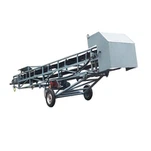
This page covers standard Trough Belt Conveyors installed on a slope. It is crucial to understand the physics: smooth rubber belts rely on friction.
- The "18-Degree Rule": For most bulk materials like crushed stone or coal, the maximum safe angle for a smooth belt is 18°.
- What happens if you go steeper? Material will start to tumble backward. If you need >20°, please check our Sidewall Belt Conveyor or Chevron Pattern Belt.
Safety Feature: The Backstop
The most critical component on an inclined conveyor is the Backstop (Anti-Runback Device).
- The Risk: If the power fails while the belt is loaded with 50 tons of rock, gravity will pull it backward, causing a catastrophic pile-up at the tail.
- The Solution: We install a mechanical backstop inside the gearbox or on the pulley shaft. It allows forward motion but instantly locks if the shaft tries to reverse.
Structure Types
- Channel Steel Frame: For shorter lengths and lighter loads. Cheaper and easier to install.
- Truss Frame (Lattice): For long spans (e.g., crossing a road or rising high into a silo). The truss design offers superior rigidity and wind resistance with fewer support legs.
Technical Data
- Inclination: 0° - 18° (Standard Smooth Belt).
- Belt Width: 500mm - 1400mm.
- Idlers: 3-roll troughing idlers (35° angle) to cup the material.
- Drive: Electric Motor + Reducer + Backstop.
Advantages And Characteristics
1. The structure is simple, easy to maintain, has low energy consumption, and low operating costs.
2. It can achieve multi-point loading and unloading.
3. Low noise, suitable for the quieter working environment.
4. The main components have strong interchangeability and versatility.
5. The conveying is smooth and reliable, and there is no relative movement between the material and the conveyor belt, which can avoid damage to the conveyed material.
6. It has strong conveying capacity, can transport over long distances, and runs reliably. It is also easy to realize automation and centralized control.
7. It has a wide range of conveying applications and can continuously transport wet, dry, powdery, and blocky materials, as well as assembled items.
8. Equipment can be customized according to different conveying processes and working environments to meet special requirements such as heat resistance, cold resistance, waterproofing, corrosion resistance, explosion-proofing, and flame.


Packing And Delivery


Typical Applications
- Crushing Plant: Lifting crushed ore from the primary crusher to the secondary crusher or screen.
- Transfer Towers: Moving material between different levels in a processing plant.
- Stockpiling: Creating conical stockpiles of aggregate.
FAQ
Q: My material rolls back at 18°. What can I do?
A: You have two options:
Reduce the angle of the conveyor (extend the length).
Switch to a Chevron (Herringbone) Belt. The patterned surface creates extra grip, allowing angles up to 25°-28°.
Q: How to calculate the power for an inclined belt?
A: Lifting requires much more power than horizontal transport. We need to know your Lift Height (meters) and Capacity (t/h) to calculate the necessary torque and select the right motor size.
Hot Tags: inclined rubber belt conveyor machine, China inclined rubber belt conveyor machine manufacturers, suppliers, factory, Fixed Belt Conveyor Machine, Rubber Belt Conveyor Machine, Idler Roller Belt Conveyor, Trough Belt Conveyor, Rubber Mobile Belt Conveyor, Flat Rubber Belt Conveyor Machine