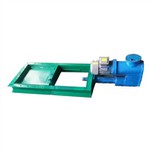


Screw conveyor is a kind of machinery that uses a motor to drive the screw rotation and push the material to achieve the purpose of conveying. It can convey horizontally, oblique or vertically, and has the advantages of simple structure, small cross-sectional area, good sealing, convenient operation, easy maintenance, and convenient closed transportation. Screw conveyor is divided into two types: shaft screw conveyor and shaftless screw conveyor in the form of conveying, and U-shaped screw conveyor and pipe screw conveyor in appearance. Shaftless screw conveyor is suitable for non-sticky dry powder materials and small particle materials (such as: cement, fly ash, lime, grain, etc.), while shaftless screw conveyor is suitable for conveying materials made of viscous and easy winding. (For example: sludge, biomass, garbage, etc.) The working principle of screw conveyor is that the rotating screw blades move the material and carry out screw conveyor transportation, so that the material does not rotate with the screw conveyor blade The force is the weight of the material itself and the frictional resistance of the screw conveyor casing to the material. The screw blade welded on the rotating shaft of the screw conveyor, the surface type of the blade has solid surface type, belt surface type, blade surface type and other types according to the different materials to be transported. The screw shaft of the screw conveyor has thrust bearings at the end of the material movement direction to give the axial reaction force of the screw with the material, and when the length of the machine is long, an intermediate hanging bearing should be added.