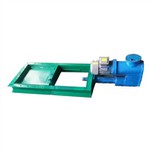


There are two types of feeders: open type and closed type. Common feeders include electromagnetic vibration feeder, bar vibrating feeder, screw feeder.
Electromagnetic vibration feeder
The vibrating feeder has simple structure, stable vibration, uniform feeding, good continuous performance and adjustable excitation force; Change and control the flow at any time, easy to operate; The eccentric block is the excitation source, with low noise, low power consumption, good adjustment performance, and no punching phenomenon; If the enclosed body is used, dust pollution can be prevented. Easy to operate, no need to moisturize, low power consumption; The feed volume can be adjusted evenly; Therefore, it has been widely used. Generally used for loose materials. According to the performance requirements of the equipment, a block plate of sufficient height should be set at the discharge at the bottom of the silo.
The vibrating feeder feeders feed lumpy and granular materials evenly and continuously from the silo to the receiving device. In the sand and gravel production line, the crusher can be fed continuously and evenly to avoid the blockage of the crusher's feeding inlet.
Compared with other feeding equipment, electromagnetic vibration feeder has the following characteristics:
(1) Small size, light weight, simple structure, easy installation and maintenance;
(2) Non-rotating parts, no lubrication, no motor and reducer, low operating costs;
(3) Because the feeder uses the resonance principle of mechanical vibration, the duplex works in the lower critical near-resonance state, so the consumption of electric energy is small;
(4) For the electromagnetic vibration feeder controlled by thyristor half-wave rectifier line, the feeding amount can be conveniently steplessly adjusted by adjusting the thyristor opening angle, and the centralized control and automatic control of the production process can be realized;
(5) Because in the feeding process, the material is continuously thrown in the feeding chute, and the jump movement is made forward according to the parabolic trajectory, so the wear of the feeding chute is small.
The disadvantage of electromagnetic vibration feeder is that the adjustment after installation is more complicated, the debugging is not good, there is not only noise, but also the operation is not good.
The electromagnetic vibration feeder can convey a variety of loose granular and powdery materials, and can also convey large pieces of materials with a particle size of up to 500mm. For powdery materials, sealed feeding can be adopted. The feeder is not suitable for conveying viscous and wet materials, nor is it suitable for transporting hot materials above 300 °C and occasions with explosion-proof requirements.
According to the requirements of the production process, the feeding capacity of the electromagnetic vibration feeder is adjusted, usually using the following three methods:
(1) Adjust the amplitude of the feeder, within the rated amplitude range, by rotating the potentiometer knob of the control box, the amplitude can be directly adjusted, so that the feeding capacity of the feeder can be adjusted steplessly;
(2) Adjust the size of the opening of the gate of the silo outlet to increase or decrease the thickness of the material layer in the feeding chute to achieve the purpose of adjusting the feeder capacity;
(3) Change the installation inclination angle of the feeding chute to realize the adjustment of the feeding volume.
The electromagnetic vibration feeder products that have been finalized and produced include GZ type general series electromagnetic vibration feeder, GZV series miniature electromagnetic vibration feeder, etc.
Commonly used GZ series electromagnetic vibration feeder has complete specifications, large production capacity and wide range of applications, the types and uses of the machine are:
(1) Basic type (model: GZ1~GZ11), its structural form is down-oscillation type, used for feeding without special requirements;
(2) Up-mode type (model: GZ3S-GZ8S), its structural form is up-vibration type, the electromagnetic vibrator is installed above the feeding chute in the opposite direction to the basic type, for installation and use when the configuration space is not enough, and the others are the same as the corresponding basic type;
(3) Closed type (model: GZ1F~GZ6F), suitable for fragile particles, dust and volatile materials;
(4) Light groove type (model: GZ5Q~GZ8Q), suitable for light materials with small bulk density;
(5) Flat groove type (model: GZ5P~GZ7P), suitable for uniform feeding of thin material layer, can be used for batching (such as coal blending);
(6) Wide trough type (model: GZ5K1~GZSK4), suitable for coal preparation, can also be used to feed to screening equipment.
The reasonable process configuration and installation of electromagnetic vibration feeder directly affect its performance and feeding capacity, so the following points should be noted.
(1) The electromagnetic vibration feeder cannot withstand excessive bin pressure, because this will reduce the amplitude of the feeder, thereby affecting the feeding capacity. In order to ensure the normal operation of the feeder, the influence of the silo pressure on the feeder must be minimized, usually the vertical projection silo pressure area acting on the feeding tank body is controlled, so that it is less than 1/5~1/4 of the silo outlet area; It is also possible to configure the chute, and use the rear side plate of the chute to bear the vertical pressure of the column.
(2) In order to facilitate the adjustment of the thickness of the material layer in the feeding chute and to stop the material from flowing out of the silo when the feeder is overhauled, a gate should be set at the discharge port of the silo or on the chute. In order to avoid the feeder tank body being damaged by the impact of the material, under normal circumstances, the silo is not allowed to be unloaded, and a certain amount of oblique material should be maintained in the silo and feeder. If the material on the empty silo and feeder needs to be unloaded due to material change or other reasons, the gate should be closed after unloading the material to prevent the impact of the material on the tank body when loading again.
(3) Whether the installation inclination angle of the electromagnetic vibration feeder is selected appropriately or not has a great influence on the feeding capacity. It is usually recommended to install an inclination angle of 10° downward, because the feeding capacity of the feeder can be increased by more than 30%. However, the inclination angle is preferably not greater than 10 ° ~ 15 °. Because the inclination angle is too large, the sliding of the material increases, which will accelerate the wear of the tank. Depending on the process configuration, the feeder tank can also be installed at an upward inclination, but this will reduce the feeder's feeding capacity.
When GZ series electromagnetic vibration feeder is used for feeding, its installation inclination angle is recommended to be 10° downward; For viscous materials and materials with large moisture content, the downward tilt angle can also be increased to 15°; When used for batching, quantitative feeding or automatic weighing, in order to ensure the uniform and stable feeding volume and prevent the self-flow of materials, the feeder should be installed and used horizontally.
(4) GZ series electromagnetic vibration feeders are all suspended installation. The suspension boom usually adopts steel wire rope, in order to reduce the lateral swing of the feeder, the two suspension booms on the feeding chute should be opened outwards10. Layout; The four suspension booms should be suspended from a structure with sufficient rigidity. For large feeders, in order to repair and replace the feeding chute conveniently, a mobile carriage should be arranged.
(5) The electromagnetic vibration feeder is generally installed as a whole. After installation, no rigid accessories are allowed to be connected to the feeder, and there should be a certain swimming gap around it, so that the feeder does not collide with other equipment. This gap is generally as minimum as 50 RAM in the length direction of the feeder; 25mm in the width direction.
(6) The installed feeder should be horizontal horizontally to avoid the material being offset to one side when the feeder is working.
Bar feeder
The bar feeder machine mechanism is simple, easy to use and maintain, the excitation force is relatively small, and there are no wear-resistant parts, which is simple. Widely used in crushing and screening production lines in mines, crushed stone yards, metallurgy, building materials, chemical industry, mineral processing, coal mines and other industries.
Bar feeder working principle: feeder new vibration motor drive, the series feeder for uniform feeding in front of the coarse crusher, at the same time due to the role of the bar screen surface, but also can remove soil and other fine materials, to achieve the function of pre-screening, can improve the coarse crushing capacity, the series of vibrating feeder new vibration motor or exciter excitation, frame type ring groove rivet riveting, manganese steel made of protective plate and bar bar, solid structure, high strength, impact resistance, wear resistance, easy to use and maintain.
The bar vibrating feeder is designed and manufactured by absorbing Swedish technology, and adopts the vibration motor produced in Japan as the excitation source. This series feeder is used for uniform feeding of large materials in front of the coarse crusher, and at the same time, due to the role of the bar screen surface, it can remove fine crushed materials such as dirt to achieve the pre-screening function and improve the coarse crushing capacity. It is especially suitable for hydropower industry, building stone, metal ore and other feeding materials before coarse crushing.
Screw feeder
The screw feeder will pass the material through the weighing bridge to detect the weight to determine the weight of the material on the tape, installed in the tail of the digital speed sensor, continuously measure the operating speed of the feeder, the pulse output of the speed sensor is proportional to the speed of the feeder, the speed signal and weight signal are sent to the feeder controller together, the microprocessor in the controller is processed, and the cumulative amount / instantaneous flow rate is generated and displayed. The flow rate is compared with the set flow, and the frequency converter is controlled by the output signal of the control instrument to change the driving speed of the feeder, so that the material flow on the feeder changes, approaching and maintaining the set feed flow, so as to achieve the requirements of quantitative feeding.